 SentnelOps
Agent identity
Every AI agent in your organisation gets a named, owned, revocable identity — an employee record for software. This layer is the directory the rest of SentnelOps is built on.
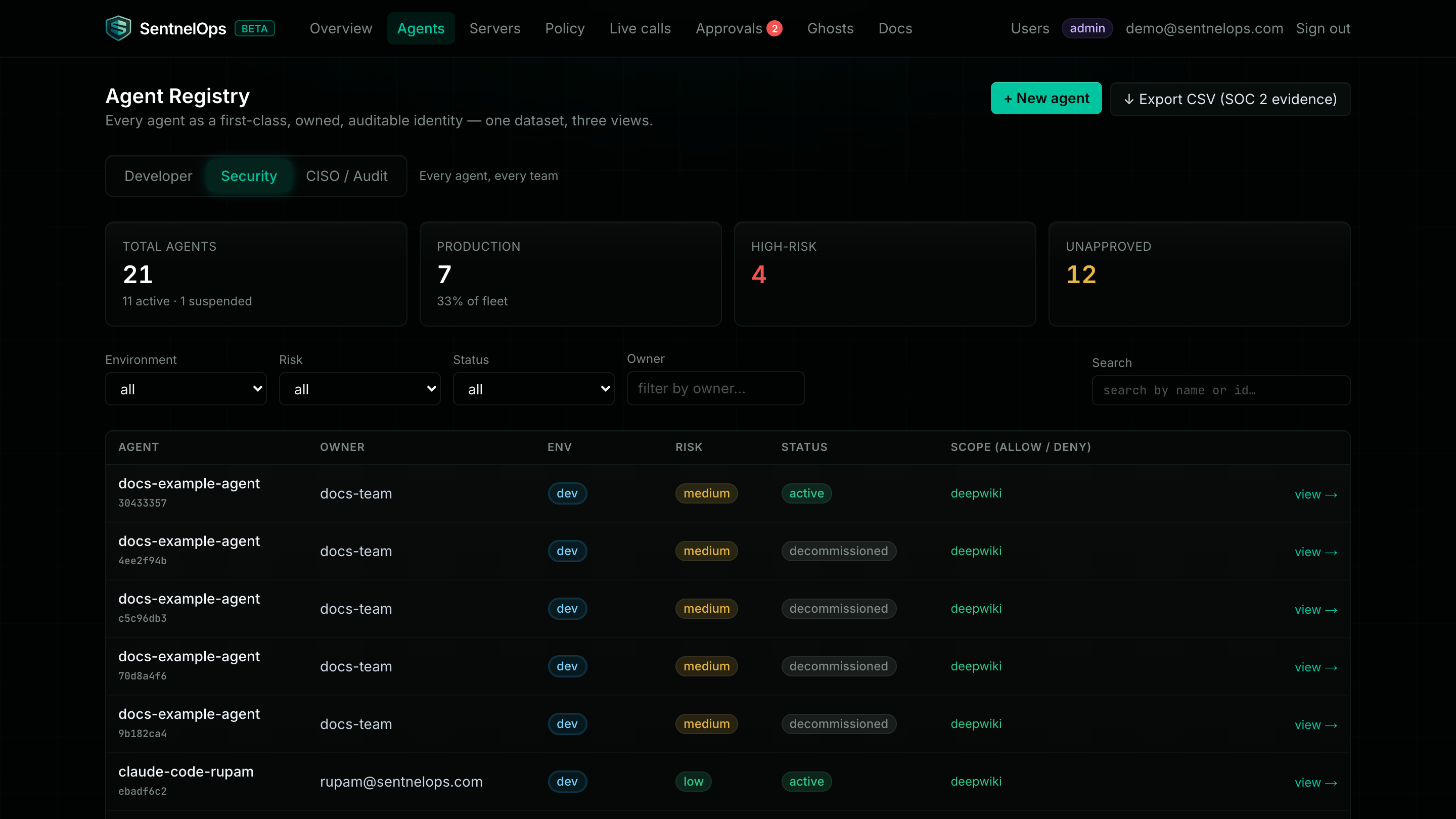
Layer 1 answers one question: which AI agents exist here, and who is responsible for each one? Registering an agent creates a record — name, owner, environment, risk level, and the MCP servers it may touch — and mints its credential: a self-contained agent token shown exactly once. Nothing about how your agent runs changes; identity is a directory, not a checkpoint.
The credential is what makes the directory operational. Every call through the SentnelOps proxy carries the agent token, so every action is attributable to a registered identity — and a human can revoke that identity from a web page, in seconds, without touching code. Rotation and decommission revoke the exact token in the database, and the proxy enforces it on the very next call (within a ~5-second cache window).
At a glance
| What it governs | Who an agent is: name, owner, environment, risk level, declared MCP scope, and its credential. |
| Key objects | The agent record (the registry row), the agent token (per-agent HS256 JWT, shown once), and the org API key (snops_key_…, for humans and CI — never for agents). |
| Where it lives | The Agents page in the dashboard (the registry), and the /agents API. Public identity documents at /cimd/{agent_id}.json. |
| Depends on | Nothing — this is layer 0 of trust. You can adopt identity alone, before routing any traffic. |
| Consumed by | Layers 2–4: lifecycle & policy decide what the identity may do, the proxy authenticates it on every call, and enforcement acts in its name. |
When you need it
Register agents under layer 1 when any of these is true:
- Someone asks “which AI agents exist here, and who owns them?” and the honest answer is a shrug.
- An agent holds production credentials and nobody could revoke them in under a minute.
- You want per-agent attribution in logs before you adopt the proxy or any policy.
- Your MCP servers want to know who is calling — the public
/cimd/…identity document answers that. - Compliance wants an inventory of autonomous software with named human owners.
What this layer does not do
Registration is voluntary: an unregistered agent is not stopped by identity alone — finding those is what ghost detection and the proxy (layer 3) are for. Identity by itself observes and enforces nothing; it answers “who exists?”, not “what are they doing?”. And tokens today are HS256 shared-secret JWTs, not asymmetric protocol identity. The honest per-layer trade-offs are laid out side by side in The five layers.